Bird Dog Pose: The “Simple” Core Exercise Most People Do Wrong
- Mar 10
- 5 min read

Bird Dog—called Pointer Dog in some yoga circles—is everywhere.
You’ll see it in yoga classes, physical therapy programs, Pilates studios, and strength training routines. The instructions are usually simple:
Lift one arm. Lift the opposite leg. Hold.
But when you look closely, something interesting happens.
Most people aren’t actually doing the pose the way it’s intended.
Instead of training core stability, they’re arching the low back, shifting the pelvis, or letting the spine move every time the limbs move.
The result? The core isn’t really stabilizing anything.
When practiced well, however, Pointer Dog is one of the most powerful poses for learning a foundational skill: how to move the limbs while the spine stays stable.
Why Neutral Spine Matters
The real goal of Pointer Dog is not balance.
It’s not range of motion.
And it’s not lifting the arm and leg as high as possible.
The real goal is maintaining a neutral spine while the limbs move.
Neutral spine means the natural curves of the spine are preserved:
The lumbar spine maintains its gentle arch
The thoracic spine keeps its natural rounding
The neck stays aligned with the rest of the spine
While the cue might be "flatten your back" or "engage your core", the teacher is hoping you won't increase the curves too much nor flatten them completely.
The challenge is that the body rarely moves this way automatically.
Most people fall into one of two movement patterns.
The Two Core Patterns: Archers vs. Tuckers
Over time, the body develops habits for how it stabilizes the spine.
Two patterns show up again and again.

Lumbar Extension Types (The Archers)
These students tend to arch their low back too much whenever the limbs move.
You’ll see this when:
lifting a leg off the floor
reaching an arm overhead
a pronounced arch when standing up from a forward fold
the low back stays arched into a forward fold
The low back arches too readily to make movement easier.
These students usually need more abdominal tone and to slow down hip flexion.
Lumbar Flexion Types (The Tuckers)

Other practitioners do the opposite.
They tuck the pelvis and round the low back whenever movement happens.
They often struggle with:
lifting the leg without rounding
maintaining a natural lumbar curve
keeping the pelvis neutral
For them, the goal is not flattening the back further—it’s learning how to allow the spine to maintain its natural curves, improve hip hinge and stop over-engaging their too short abdominals.
Why Dead Bug Is a Great Preparation

One of the easiest ways to learn spinal stability is to turn the pose upside down.
Dead Bug gives the body something extremely helpful: feedback from the floor.
When you lie on your back, the floor helps you feel if your core is actually staying stable:
the low back maintains its arch (lumbar flexion types)
the lumbar spine is reduced or flattened (lumbar extension types)
the pelvis stays neutral (hip points and pubic bone are level)
Simple progressions make this exercise surprisingly challenging.
Examples include:
lifting one foot at a time
tapping one foot to the floor from a knees over hips starting position
reaching one leg out straight at a time
lifting and lowering both legs simultaneously
The goal in each variation is the same:
Can the limbs move without the spine changing shape?
The Most Common Mistake in Bird Dog
The most obvious mistake in Pointer Dog is often the most important one to fix.
The pelvis shifts to the side.
When you raise a leg out behind you, the pelvis drifts toward the weight-bearing leg. That thigh is no longer perpendicular to the floor. The knee is narrower than the hip joint.

Biomechanically this is hip adduction—the hip collapsing toward the midline.
This happens because the outer hip stabilizers aren’t doing their job.
Instead of letting the pelvis drifting away from the lifted leg, cue the opposite:
"Shift the pelvis toward the leg that’s lifting."
That cue activates the muscles that keep the pelvis centered.
External Feedback Works Better Than Internal Cues
Many yoga cues are internal:
“Engage your core.”
"Lift the pelvic floor.”
“Draw the navel to the spine.”
These cues may make sense to experienced practitioners, but they can be difficult to translate into a felt sense for regular students.
External cues are often far more effective.
One powerful tool is a simple pole placed along the spine, touching:
the back of the skull
the mid-back
the middle of the pelvis

The goal becomes simple:
Don’t let the pole move.
Suddenly the body receives immediate feedback if the spine arches, rounds, or rotates. If you shift around too much (unstable core), the pole will fall to the floor.
Why Transitions Matter
Interestingly, most people can hold Pointer Dog for a moment.
The real problem happens when they switch sides.
Transitions are often where stability breaks down.
The pelvis shifts to one side.
The spine and pelvis rotate.
The pole falls.
That’s why transitions are frequently the most injurious times in a yoga practice.
Cleaning up the transition between sides is often more important than holding the pose.
Variations That Build Real Stability
Once the fundamentals are clear, Pointer Dog can evolve into a wide range of useful variations.
Some favorites include:

Fire Hydrant Variation:
A bent-knee hip abduction that strengthens the outer hips and improves squaring the hips.

Quad Stretch Pointer Dog:
Adds shoulder mobility and a different balance challenge.
Floating Knee Pointer Dog:
A much stronger core challenge performed with a smaller base of support.
Side Plank to Same Leg-Same Arm Lift:
Have fun and let go of your ego in this challenging ipsilateral version.
Each variation reveals something different about how the body organizes stability.
Why This Pose Matters for More Complex Yoga Poses
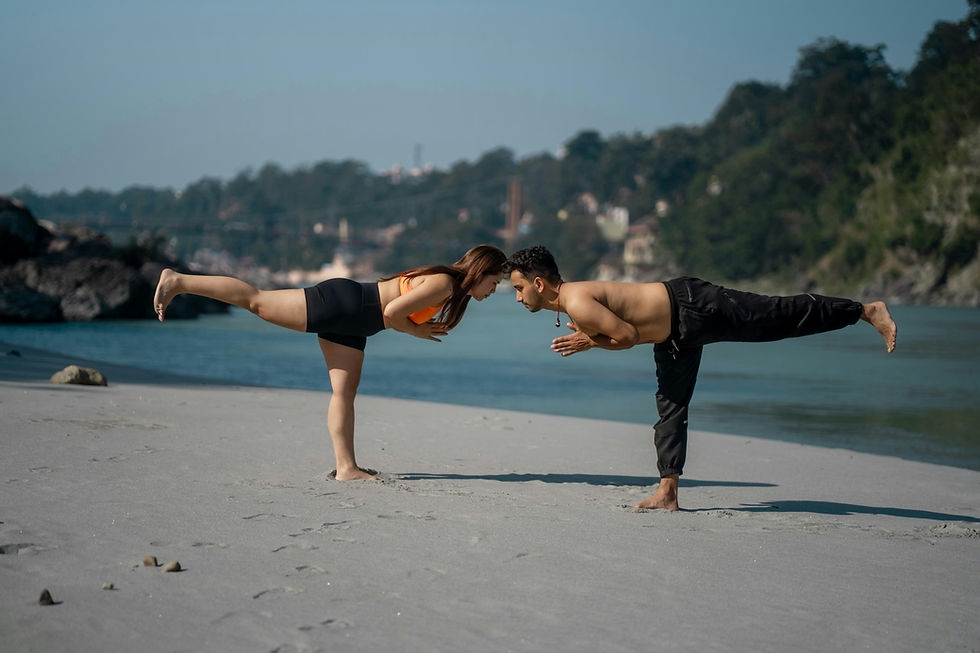
Pointer Dog may look simple, but it teaches skills used in many advanced poses.
When the hips and core are stable and the limbs move without distorting the spine, suddenly poses like Warrior 3 feel dramatically easier.
The correct muscles are already working.
Balance becomes simpler.
And the body stops relying on compensation patterns.
A Simple Pose That Reveals Everything
Pointer Dog is often treated as a warm-up.
But when practiced carefully, it becomes something much more interesting:
A diagnostic tool.
It reveals how the body stabilizes, how it compensates, and which muscles are truly doing the work.
And once you understand that, the pose stops being simple—and starts becoming incredibly useful.


Comments